

Smart litter boxes can make an invisible part of cat care visible: when a cat visits, how long the visit lasts, and—on some models—weight or waste-mass trends. That information can help a caregiver notice a change sooner and give a veterinarian a more useful timeline. It cannot identify the cause of a change, rule out disease, or replace an examination and diagnostic tests.
This evidence review explains what smart and self-cleaning litter box data can reasonably support, the most important failure modes, and the questions retailers and OEM buyers should ask before describing a product as “health monitoring.” It is a public-evidence analysis, not a customer case study, and it does not substitute for veterinary advice.
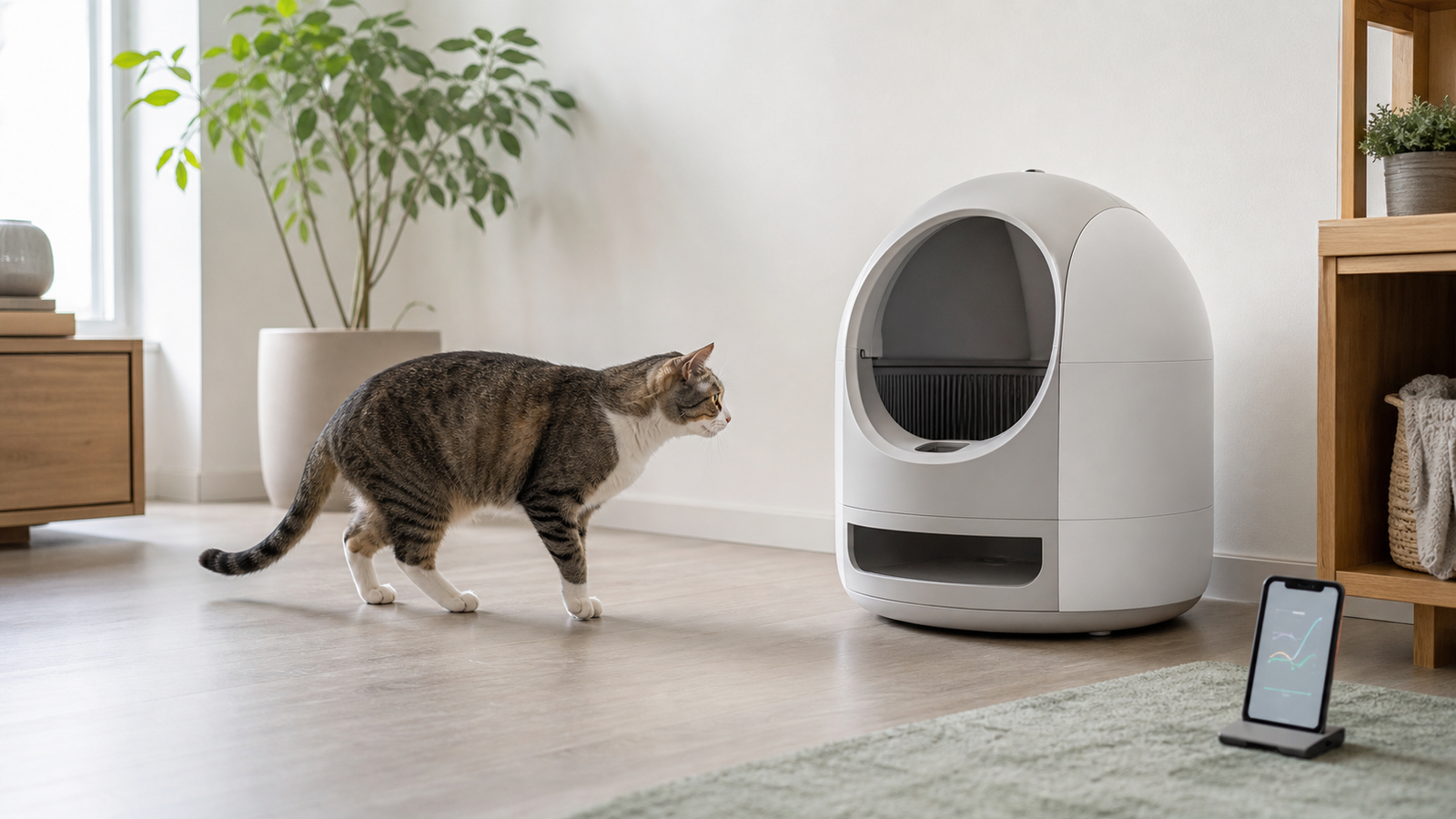
What does a smart litter box actually measure?
“Health monitoring” is not one standardized feature. Depending on the product, a smart litter box or add-on platform may record:
- the time and duration of each detected visit;
- body weight while the cat stands in or on the unit;
- changes in total box weight before and after a visit;
- an inferred urination or defecation event;
- cleaning-cycle, drawer-full, litter-level, or fault events; and
- an algorithm’s attempt to assign an event to one cat.
Those are sensor outputs and inferences—not diagnoses. Even Purina’s official page for its Petivity monitor says the system identifies changes that may be associated with conditions requiring veterinary diagnosis and is “not intended to diagnose, treat, mitigate, or cure” disease. That distinction should appear just as clearly in retail copy and app alerts as it does on the manufacturer’s technical marketing page.
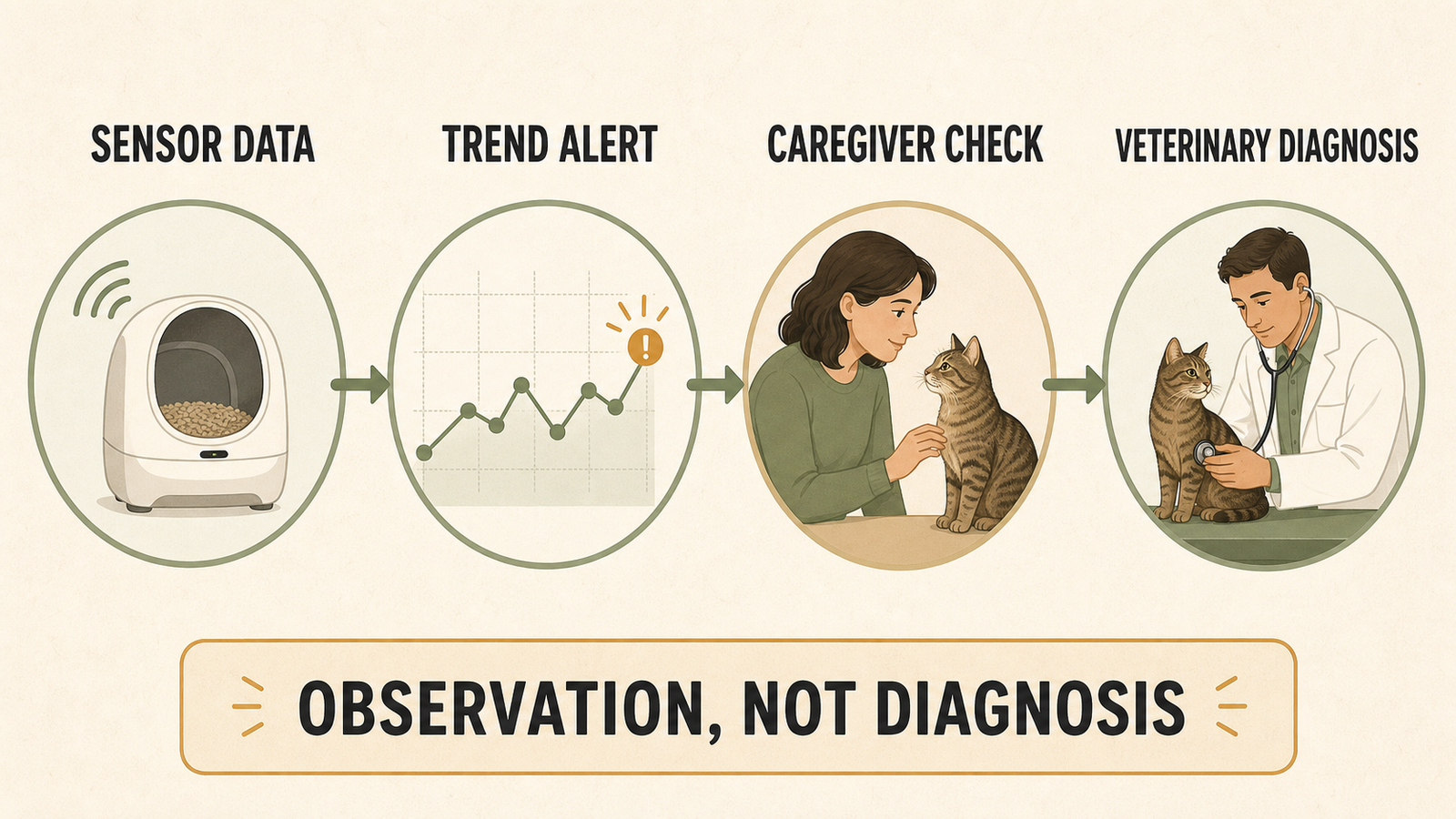
Why continuous litter box data can be useful
Caregivers do not watch every litter box visit, especially overnight or in a busy household. A prospective study from Michigan State University compared video-recorded urination behavior with caregiver observations in 11 healthy cats and eight cats with conditions that could affect urination. Video detected a mean 2.5 urinations per day, while caregivers reported 0.6; five cats were never observed in the box by their caregivers. The peer-reviewed 2017 study does not validate today’s consumer sensors, but it demonstrates the observation gap that passive monitoring is designed to address.
The most defensible use is therefore trend detection against the individual cat’s baseline. A 2026 preliminary study used a connected litter box and feeder in nine clinically healthy, single-cat households. Eight cats routinely accepted the devices and were monitored for at least 63 days. The researchers found repeatable individual feeding and elimination patterns, while also reporting reduced reliability for excrement-weight measurements and manually filtering unreliable periods. The full Journal of Feline Medicine and Surgery article supports the value of personal baselines, but its small, selected sample does not justify universal “normal” thresholds.
Promising research is not the same as a diagnostic product
A newer 2026 retrospective study explored whether smart litter box behavior could help distinguish cats with chronic kidney disease (CKD) from cats with no known conditions. Its machine-learning model reported a weighted F1-score of 92.7% in training cross-validation and 89.9% in validation. Features associated with the CKD group included more frequent urination, longer elimination duration, and less post-elimination covering. These results are encouraging, and the PubMed record and conflict-of-interest statement make the study easy to audit.
They also require careful interpretation. The work was retrospective, most authors were employed by Nestlé Purina Research, and one author served on a Nestlé Purina advisory board. A model’s performance within defined research cohorts is not proof that every consumer device can detect CKD, nor does it show that an alert can determine why a cat’s behavior changed. CKD, diabetes, hyperthyroidism, lower urinary tract disease, constipation, stress, mobility problems, a dirty box, and device error can produce overlapping signals. Diagnosis still requires a veterinarian’s history, physical examination, and appropriate laboratory or imaging tests.
Five ways smart litter box data can mislead
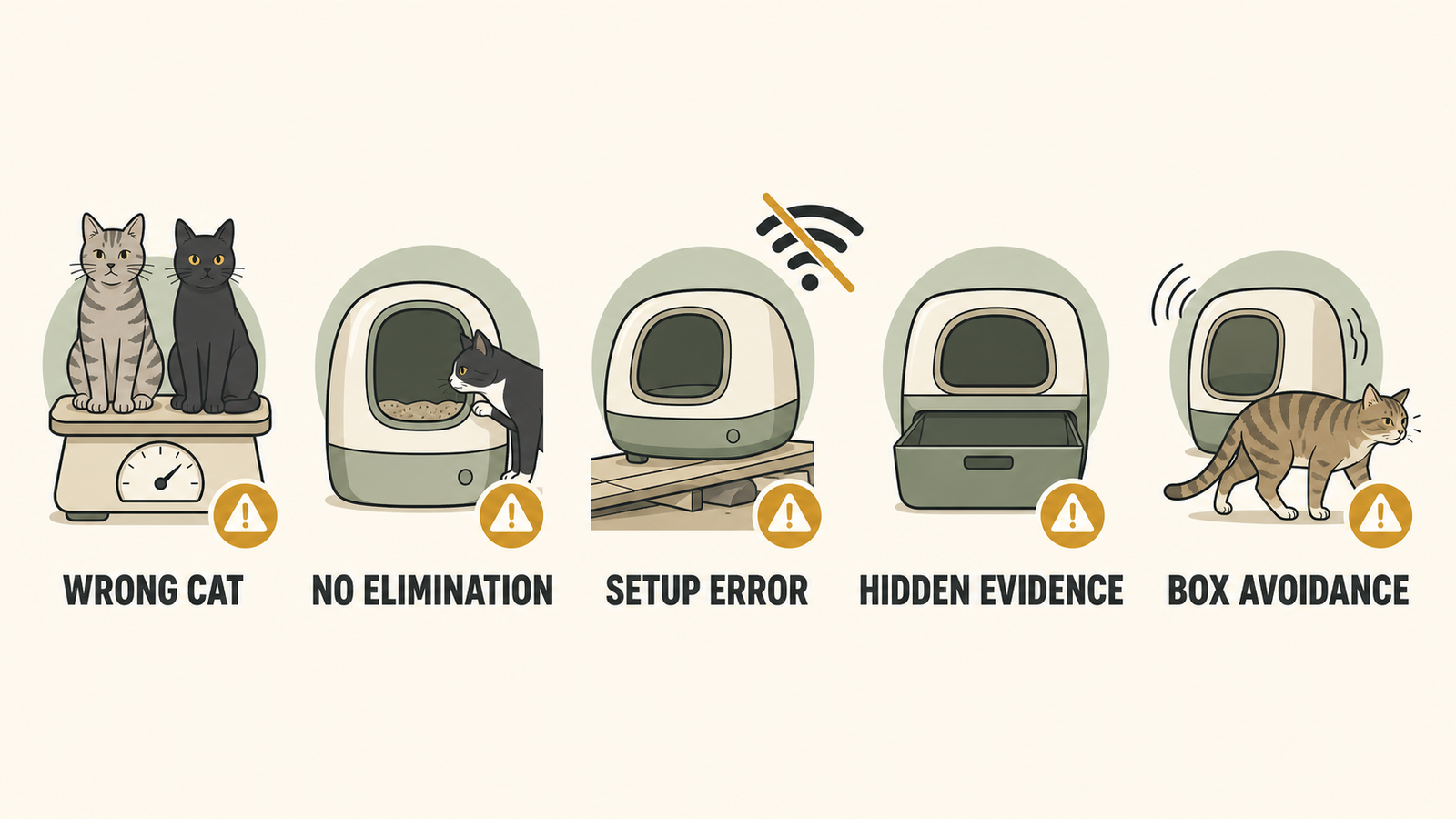
1. The system may identify the wrong cat
Multi-cat attribution is a classification problem. Whisker states that its SmartScale uses weight clusters, gathers an initial seven-day history, and may not distinguish cats whose weights are within one pound. It also says the feature requires cats to weigh at least three pounds and that soft flooring, wall contact, inaccurate profiles, or unprofiled cats can interfere. These are product-specific limits, not industry-wide thresholds, but they show what transparent documentation looks like. See the company’s official SmartScale explanation and troubleshooting limits.
2. A visit is not necessarily a successful elimination
A cat may step in, investigate, turn around, dig, or be interrupted. Weight and timing alone may not prove that urine or stool was passed. Products should distinguish measured values from inferred event labels and preserve confidence or error states instead of presenting every classification as fact.
3. Installation and maintenance affect measurements
Uneven floors, carpet, litter touching a wall, debris under a scale, overfilled litter, a full waste drawer, network outages, power loss, and firmware changes can create missing or distorted data. A credible system needs calibration instructions, fault logs, and a visible “data unavailable” state. Silence should never be presented as “your cat is fine.”
4. Self-cleaning can remove evidence before a caregiver sees it
Automation reduces scooping, but urine clump size, stool consistency, blood, diarrhea, parasites, and foreign material may be clinically relevant observations. A useful design offers a cycle delay or manual pause and lets caregivers inspect the drawer safely. The app should complement direct observation, not train people to stop looking.
5. The cat may avoid the device
Data quality depends on voluntary use. Size, entry height, noise, motion, litter substrate, location, and competition from another cat all matter. The Feline Veterinary Medical Association’s Cat Friendly Practice guide recommends boxes about 1.5 times the cat’s nose-to-tail-base length, easy access, one box per cat plus one extra in separate locations, and regular scooping. International Cat Care’s 2024 kitten guide specifically cautions that self-cleaning or automated trays may upset kittens. A smart box should not eliminate appropriate alternative toileting options.
What should a caregiver do after an alert?
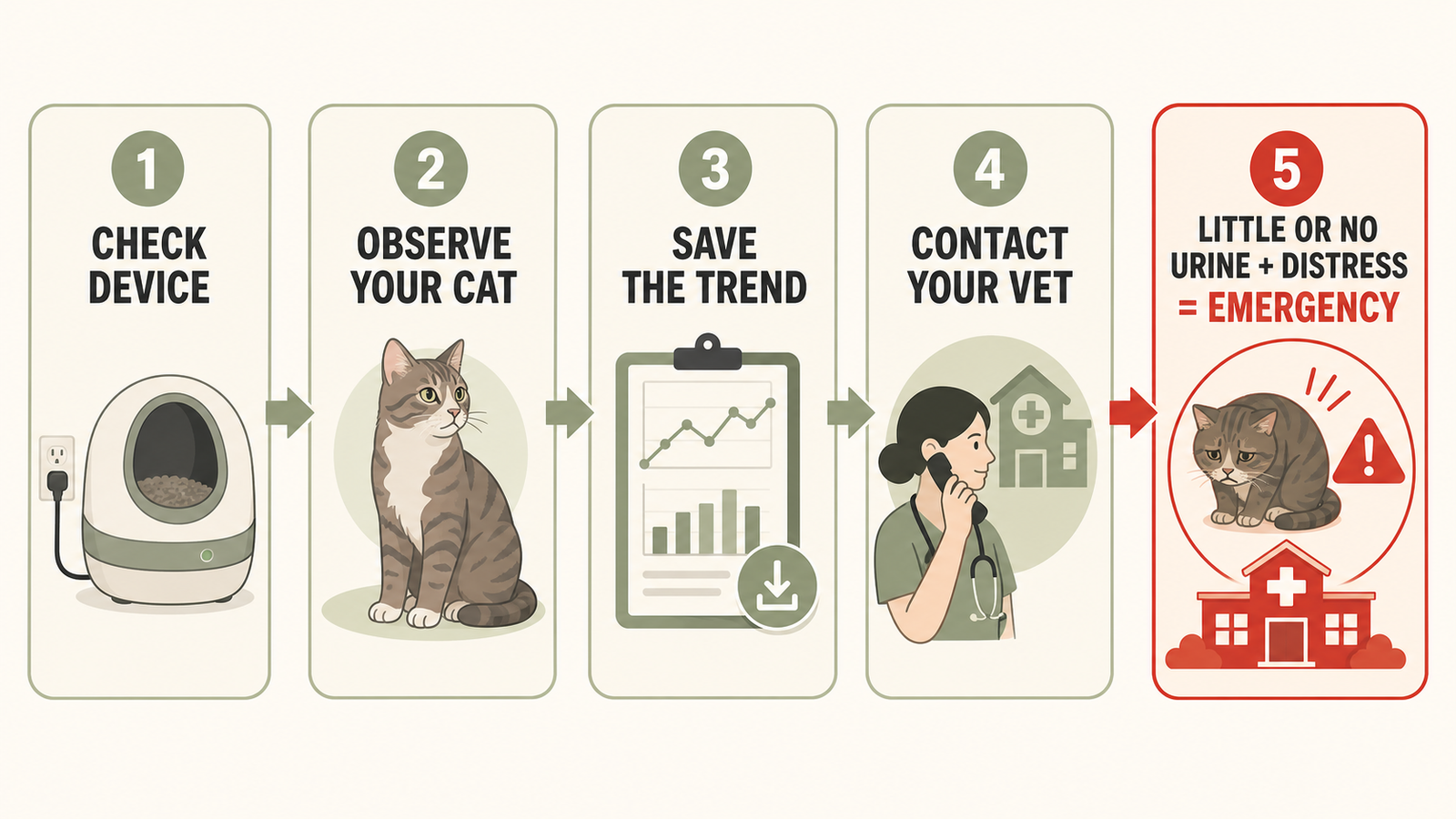
- Check the data source. Confirm the correct cat, firm placement, power and network status, litter level, recent cleaning, and whether another pet could have triggered the event.
- Look for the cat, not only the chart. Note appetite, water intake, energy, vocalization, vomiting, hiding, genital licking, repeated box trips, urine clump size, stool, and any house-soiling.
- Preserve a short, readable record. Export or screenshot the trend, including dates, raw visit history, missing-data periods, and recent household changes. Do not “smooth away” an outlier before a veterinarian reviews it.
- Contact a veterinarian when a meaningful change persists or the cat seems unwell. An alert is a prompt to gather context, not a treatment recommendation.
- Treat urinary obstruction signs as an emergency. The American Veterinary Medical Association lists straining, frequent small urinations, crying, genital licking, blood, and urinating outside the box among lower urinary tract signs. A cat—especially a male cat—straining while producing little or no urine and becoming distressed needs immediate veterinary care. The AVMA feline lower urinary tract disease guide explains why waiting for another app alert is unsafe.
An evidence-based checklist for retailers and OEM buyers
Before placing “health monitoring” on packaging or a product page, ask the supplier for answers that can be tested:
- Measured versus inferred: Which outputs come directly from sensors, and which are algorithmic labels?
- Cat identification: How does the system handle similar-weight cats, kittens, visitors, partial entries, and cats without profiles?
- Accuracy conditions: What floor, litter, fill level, cleaning schedule, and calibration are required? Are accuracy and repeatability data available for each metric?
- Missing data: Does the app mark outages, sensor faults, manual cycles, and discarded readings?
- Useful history: Can a caregiver export raw, time-stamped events and share a clear report with a veterinarian?
- Responsible alerts: Do messages state that changes require context and veterinary diagnosis? Do urgent urinary signs receive an unambiguous emergency instruction?
- Cat welfare: Are entry size, accessibility, noise, cycle delay, manual mode, acclimation guidance, and alternative-box guidance documented?
- Validation transparency: Are study population, comparator, sample size, exclusions, funding, conflicts, and false-positive/false-negative performance disclosed?
A product that cannot answer these questions may still be a convenient self-cleaning litter box. It should not be promoted as a medical-grade monitor.
Frequently asked questions
Can a smart litter box diagnose a UTI or kidney disease?
No. It may detect a change in visits, weight, duration, or inferred elimination, but those signals have multiple possible causes. Veterinary examination and diagnostic testing are required.
Is a single unusual reading an emergency?
Not by itself; first check identity and device conditions. However, do not wait on trend data when the cat is straining, producing little or no urine, crying, or becoming distressed—seek immediate veterinary care.
Does automatic cleaning mean I no longer need to inspect the waste drawer?
No. Periodic direct inspection can reveal changes a sensor may not classify, and the unit still requires cleaning and maintenance according to its manual.
Can one smart box replace every other litter box in a multi-cat home?
That conflicts with feline-friendly guidance to provide one box per cat plus one extra, distributed in separate, accessible locations. Multiple options also protect the cat when a device is offline or disliked.
Compare connected and non-connected product architectures
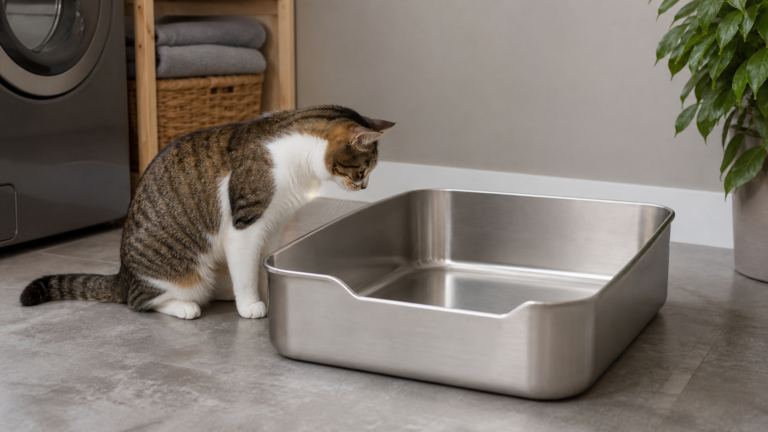
For buyers defining a smart litter box program, compare monitoring claims with the simpler mechanical requirements of a representative open-top stainless steel litter box and an enclosed stainless steel litter box. Use our stainless steel litter box design guide to review usable dimensions, entry geometry, corner design, and cleanability before sensors and app features are added.
Bottom line
Smart litter box data is best treated as a home observation log: valuable for revealing a personal baseline and flagging change, but incomplete and vulnerable to attribution, installation, acceptance, and algorithm errors. For responsible brands, the strongest claim is not “this box diagnoses disease.” It is “this system helps caregivers notice and document changes to discuss with a veterinarian.”
For OEM and private-label projects: ask our team about sensor specifications, manual-mode behavior, event-history design, and validation documentation before selecting health-monitoring claims for your smart litter box program.
Sources
- Migny R, Concordet D, Reynolds BS. Characterising individual feeding and elimination behaviours in healthy cats using a connected smart feeder and litter box: a preliminary study. Journal of Feline Medicine and Surgery. Published January 3, 2026.
- Langenfeld-McCoy N, et al. Enhancing Detection of Feline Chronic Kidney Disease Through Smart Litter Box Monitoring. Animals. Published April 25, 2026.
- Dulaney DR, et al. Quantification of Urine Elimination Behaviors in Cats with a Video Recording System. Journal of Veterinary Internal Medicine. Published March 3, 2017.
- American Veterinary Medical Association. Feline Lower Urinary Tract Disease. 2024 client guide.
- American Association of Feline Practitioners. A Guide to Creating a Cat Friendly Practice. 2023 guide edition.
- International Cat Care. Caring for Your New Kitten. 2024 booklet.
- Whisker. SmartScale feature and troubleshooting information. Undated product technical page; accessed July 23, 2026.
- Purina. Petivity Smart Litterbox Monitor System. Undated official product page; accessed July 23, 2026.
Evidence limitations
Research on connected litter boxes is still limited and device-specific. The 2026 healthy-cat study enrolled nine cats from single-cat households and reported reliability issues for excrement-weight data. The 2026 CKD study was retrospective and had substantial manufacturer affiliations; its reported model performance should not be generalized to other devices or home populations. The 2017 video study demonstrates missed caregiver observations but did not test a consumer smart litter box. Manufacturer pages are primary sources for their own specifications and disclaimers, not independent proof of clinical accuracy. No customer testimonial, private case note, or sales claim was used. The target site’s public posts were checked through accessible search indexing, but a complete WordPress API inventory was unavailable during this run, so duplication review may not include unindexed posts. All sources were accessed July 23, 2026.
Leave a Reply