

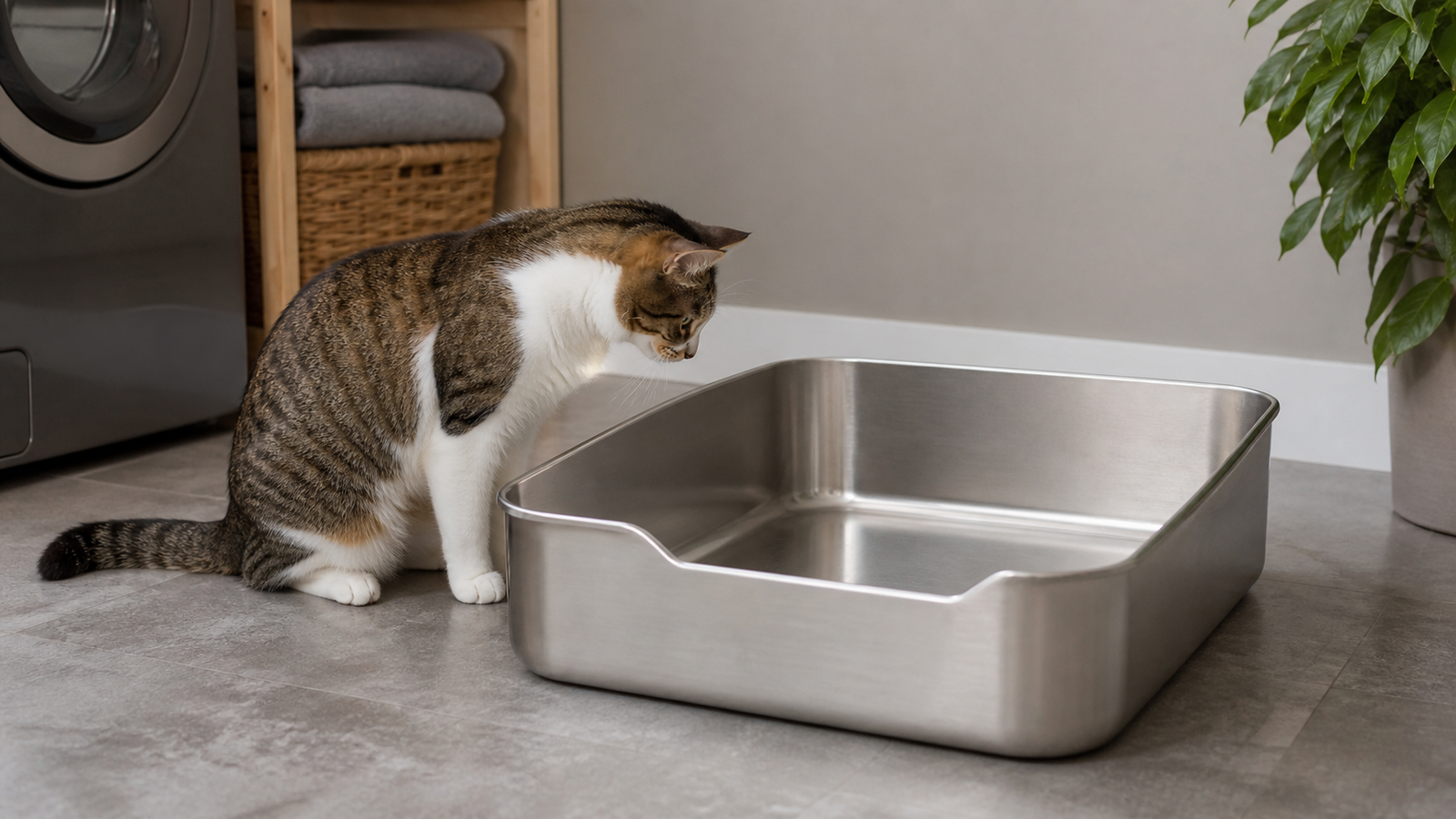
A stainless steel litter box brief should begin with the cat, not the metal finish. A polished sample can still fail if its usable floor is too short, its doorway asks an older cat to climb, or its folded seams trap damp litter. For OEM buyers, private-label teams, and retailers, those details are more useful than an unsupported claim such as “odor-proof” or “antibacterial.”
This guide translates feline behavior evidence and cleanability principles into a practical specification. The short answer is: define usable internal dimensions from the target cat population; make entry easy without sacrificing containment; keep soil-contact surfaces smooth, visible, and reachable; and validate the assembled product rather than approving a material coupon alone.
1. Specify usable internal size, not carton-friendly outside dimensions
The corrected AAFP/ISFM house-soiling guidelines recommend a rectangular box about 1.5 times the cat’s nose-to-tail-base length. They also cite a home study in which adult cats preferred an 86 × 39 cm box over a 56 × 38 cm box. The underlying 2014 litter-box size study involved 74 privately owned cats in 43 households over four weeks. That is meaningful preference evidence, but it is not a universal product standard or a promise that one size will prevent house-soiling.
A 2025 peer-reviewed Japanese study of litter-box size and litter type found higher preference for general-use boxes at least 50 cm long in its study population. The authors cautioned that most cats were medium-sized mixed breeds and larger cats may need more space. One author was employed by a pet-products company, and the test settings and litter choices limit how broadly the result should be applied. Taken together, the studies support offering cats room to enter, turn, dig, eliminate, and cover; they do not support reducing the rule to a single global SKU.
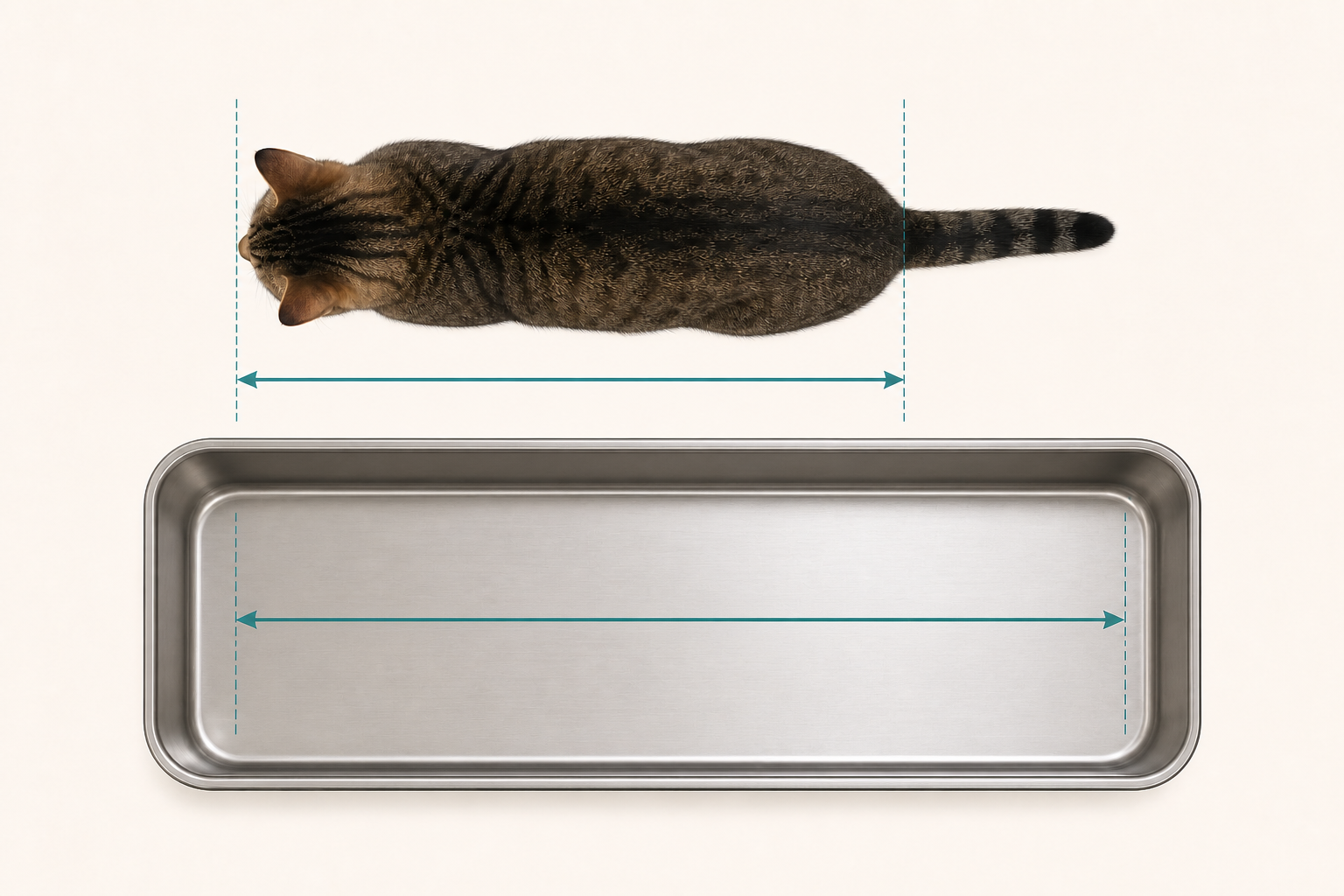
On a factory drawing, label four values separately: external length, internal rim length, clear floor length, and internal width. Rolled rims, corner radii, tapered walls, removable shields, and an inset doorway can all reduce usable space. Ask the supplier to measure finished samples at the narrowest functional points. If the target market includes large breeds or multi-cat homes, do not claim suitability from external dimensions alone.
2. Treat entry height and wall height as different requirements
Containment usually favors higher sides; access may favor a lower entry. The AAFP/ISFM guidelines specifically note that a low entry can facilitate use by an older cat or a cat with degenerative joint disease. International Cat Care’s 2024 kitten-care booklet likewise advises a lower-sided tray for kittens that cannot comfortably negotiate adult-sized walls. Neither source defines one mandatory entry height for every cat.
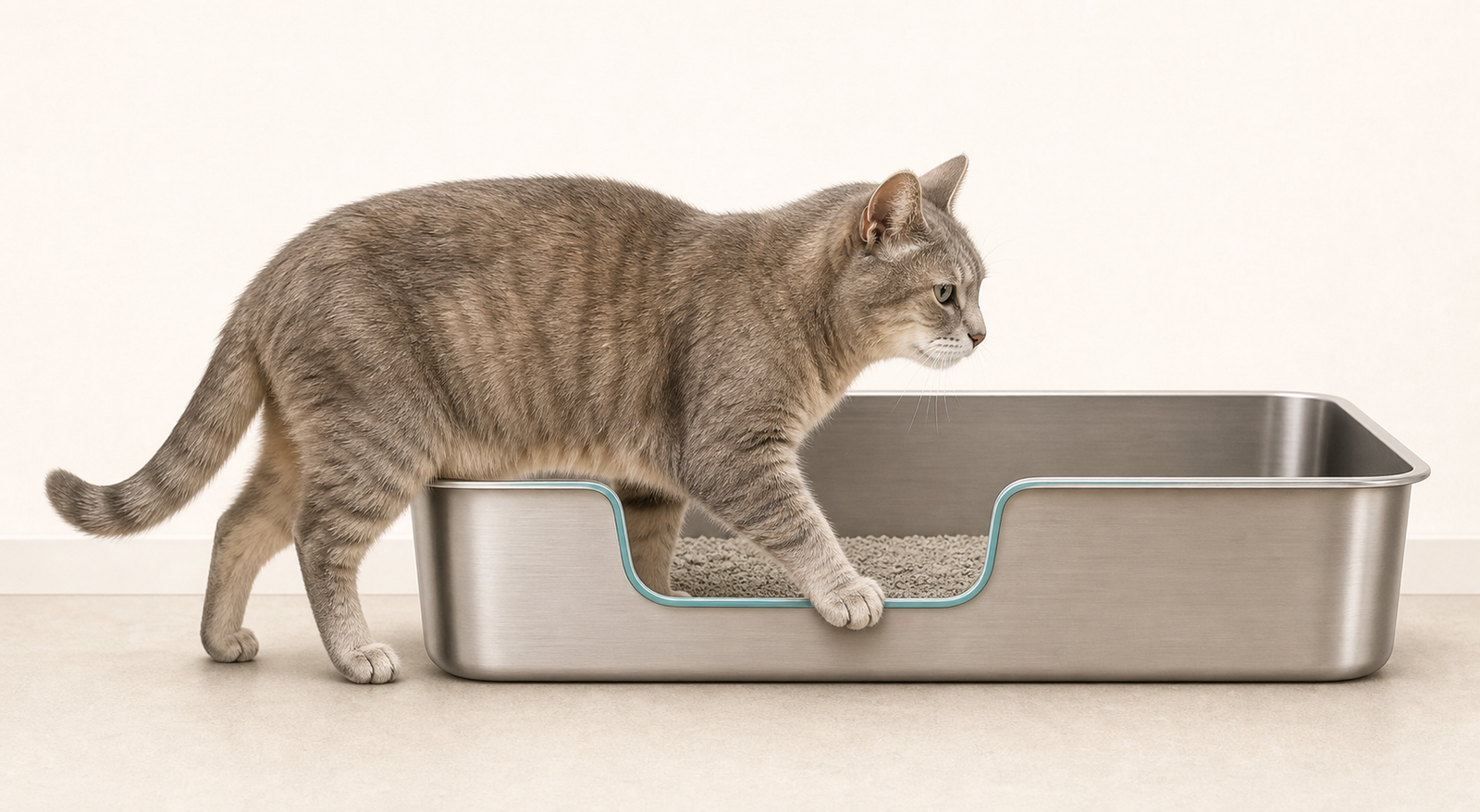
A useful brief therefore defines an entry zone and a containment zone. Require a broad, smoothly radiused opening with no sharp transition where paws or skin may contact the edge. Keep enough front-wall stiffness that the opening does not flex into a pinch point when the loaded tray is lifted. Prototype reviews should include kittens, healthy adults, senior cats, and cats with mobility limitations only under appropriate owner or veterinary supervision; a product team should never diagnose mobility problems from litter-box behavior.
Also decide whether a hood is optional. A study of covered versus uncovered boxes found no overall group preference when the boxes were large and maintained, while individual cats did show preferences. The AAFP/ISFM guidelines favor open boxes when possible because owners can monitor and scoop them more easily. For a stainless tray platform, a removable shield or hood can preserve choice better than making enclosure unavoidable.
3. Design the assembled tray for cleaning
Stainless steel is a family of alloys, not a sterility guarantee. Grade, sheet thickness, forming, welding, finishing, and cleaning chemistry all matter. More importantly, a smooth material can become hard to clean after fabrication if a folded joint, exposed fastener, rough weld, or tight corner creates a hidden reservoir.
World Stainless guidance for commercial equipment says smooth surfaces retain less dirt than rough ones and recommends optimizing for washability while avoiding crevice-like geometries. Its broader stainless steel design guide explains that hygienic design makes equipment cleanable but does not guarantee sterility. These documents concern food equipment, not litter boxes, so their value here is a transparent engineering analogy: soil-contact surfaces should be accessible, continuous, and easy to rinse and dry.
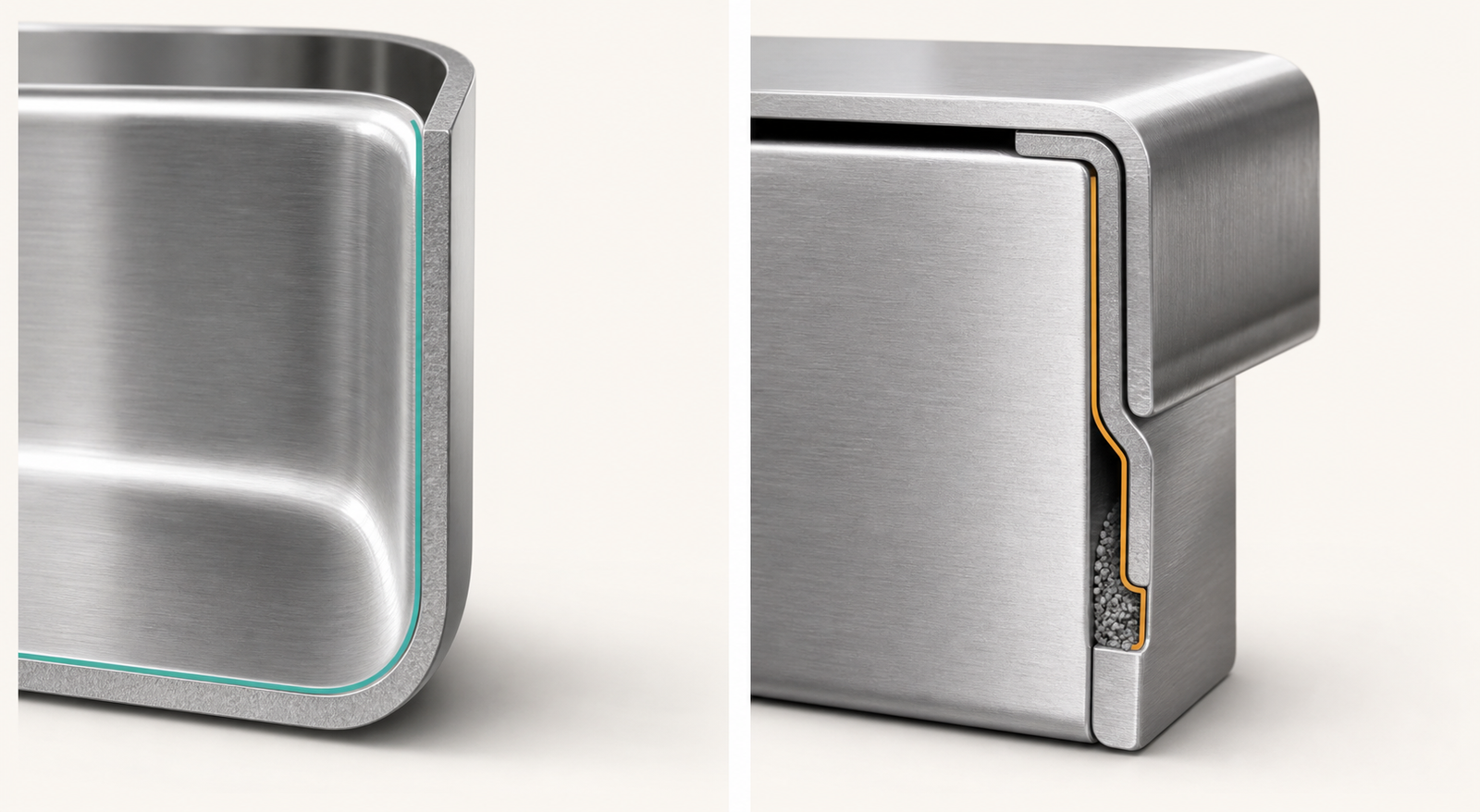
Put these checks on the drawing and inspection sheet:
- Interior continuity: prefer formed radii or finished continuous joints in all soil-contact zones.
- Reachability: a sponge or cloth should contact every interior surface without disassembly or special tools.
- Drain and dry behavior: after rinsing, inspect for water trapped under rims, shields, handles, feet, or badges.
- Edge finish: inspect rolled edges, entry cutouts, and weld transitions by sight and touch using a documented acceptance method.
- Marking discipline: keep third-party logos and unverified “medical-grade,” “antibacterial,” or “rust-proof” claims off the product and listing unless substantiated for the exact construction and intended use.
4. Validate cleaning instructions with the exact production sample
Cleaning guidance must be compatible with the finished product—not copied from a generic stainless steel article. The AAFP/ISFM guidelines recommend removing waste at least daily and washing the box periodically with soap and hot water while avoiding strong or ammonia-based chemicals. The CDC advises changing litter boxes daily, washing hands afterward, and keeping the box away from food-preparation areas; pregnant people and those with weakened immune systems should avoid the task when possible or follow the CDC’s protective steps.
For each SKU, test the labeled cleaning process on production-equivalent trays, including welds, colored coatings, bonded feet, and removable components. Record the cleaner, dilution, contact time, water temperature, rinse, dry procedure, cycle count, and observed change. A result from bare sheet does not establish compatibility for the assembled product. If disinfectant use is described, instruct customers to follow the disinfectant label and the tray manufacturer’s compatibility guidance; do not improvise chemical mixtures.
5. Use an evidence-aware prototype approval checklist
- Document the target cat sizes and mobility scenarios.
- Verify clear internal length and width on multiple finished samples.
- Confirm easy entry, stable footing, rounded contact edges, and adequate side/rear containment.
- Inspect every soil-contact corner, joint, attachment, and removable interface under bright light.
- Run repeatable fill, carry, scoop, wash, rinse, dry, and reassembly checks.
- Conduct an appropriately supervised user trial and record both acceptance and avoidance; never present a small trial as population-wide proof.
- Approve packaging and marketing only after the production design matches the tested sample.
This sequence gives buyers traceable questions to ask without pretending the evidence is stronger than it is. It also keeps feline usability and cleanability visible when cost-reduction proposals change wall taper, doorway shape, rim construction, or accessory attachment.
FAQ
Is 50 cm long enough for every cat?
No. The 2025 study found a preference threshold in its specific population, while veterinary guidance recommends relating box length to the individual cat. Larger cats may need substantially more clear internal space.
Should every stainless steel litter box have a low entry?
Not necessarily, but an accessible option is important for kittens, senior cats, and cats with limited mobility. Balance a lowered entry with containment, stiffness, and smooth edge finishing.
Does stainless steel make a litter box antibacterial?
That conclusion cannot be made from the material name alone. Alloy, finish, fabrication, soil, cleaning, and test method all affect performance. Describe verified physical attributes and cleaning instructions instead of making an untested health claim.
Is an open box always better than a covered box?
No. Research indicates individual preferences. A large open tray supports monitoring and scooping, while a removable cover or shield can preserve customer choice.
Procurement takeaway
A credible stainless steel litter box specification is a set of measurable, testable requirements: usable internal space, accessible entry geometry, stable and rounded edges, continuous cleanable surfaces, compatible cleaning instructions, and evidence-limited claims. If you are developing an OEM or private-label tray, request a dimensioned drawing and production-equivalent sample, then audit those points before approving tooling or marketing copy.
Evidence limitations
Direct peer-reviewed research on stainless steel litter-box construction is scarce. The feline studies cited here evaluate box size, litter, or cover preference, not stainless steel geometry, long-term corrosion, odor retention, or commercial return rates. The 2025 study had a manufacturer-employed author and a defined Japanese study population. World Stainless documents address food equipment and are used only as cleanability-design analogies. The original images are explanatory concepts, not test evidence. This article is educational and does not replace individualized veterinary advice; sudden house-soiling, straining, pain, or changes in elimination warrant prompt veterinary assessment.
Sources
- AAFP and ISFM Guidelines for Diagnosing and Solving House-Soiling Behavior in Cats (Journal of Feline Medicine and Surgery, 2014; corrected online version).
- Litterbox Size Preference in Domestic Cats (Felis catus) (Journal of Veterinary Behavior, 2014).
- Litter Box Size and Litter Type Preference and Their Associated Behavioral Changes in Cats (Journal of Veterinary Medical Science, 2025).
- Litter Box Preference in Domestic Cats: Covered Versus Uncovered (Journal of Feline Medicine and Surgery, 2013).
- Caring for Your New Kitten (International Cat Care, 2024).
- Cats: Healthy Pets, Healthy People (US Centers for Disease Control and Prevention, 2024).
- Commercial Food Equipment: The Ferritic Solution (World Stainless, current hosted edition).
- Stainless Steel in the Food and Beverage Industry (World Stainless/Euro Inox).
Leave a Reply