
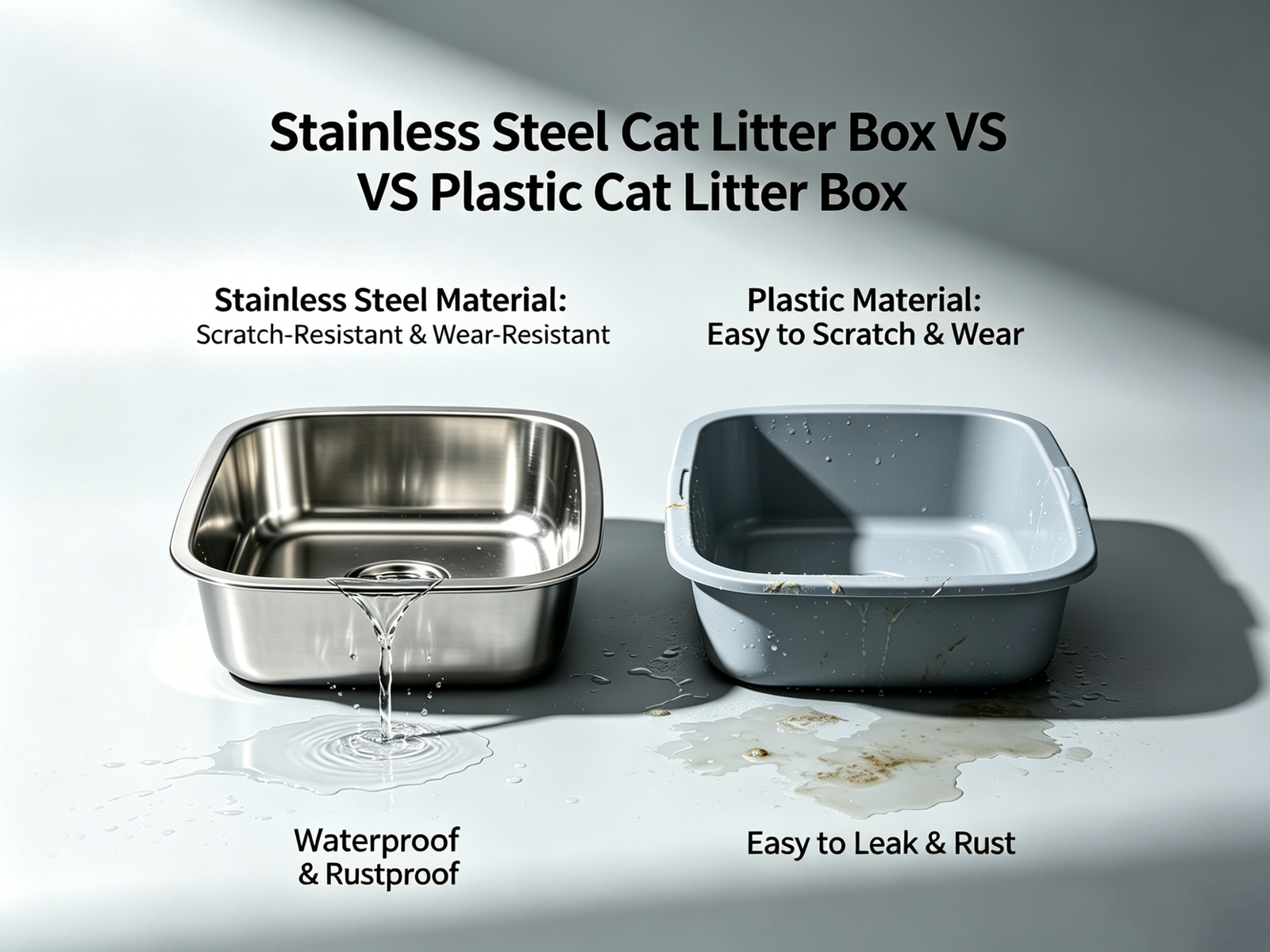

Stainless steel can be a useful material for cat litter boxes, but the material name alone does not establish hygiene, odor control, lifespan, or commercial performance. B2B buyers should evaluate the complete product: alloy specification, sheet thickness, geometry, seams, finish, accessories, packaging, cleaning instructions, and the evidence supporting each claim.
1. What Stainless Steel Can Change
- Surface and cleanability: A smooth, continuous stainless steel surface can be easier to inspect and wipe than a heavily scratched or complex surface. The assembled tray still needs accessible corners, finished joints, compatible cleaning instructions, and a design that can drain and dry.
- Durability: Stainless steel does not behave like molded plastic, but durability depends on grade, thickness, forming, welding, edge construction, coatings, loading, and use. It should not be described as indestructible or maintenance-free without product-specific testing.
- Product positioning: The material can support a premium design direction, but customer value also depends on usable internal space, entry height, litter containment, stability, appearance, packaging, and after-sales support. Buyers evaluating simple, durable configurations can explore our stainless steel open litter boxes for OEM and wholesale projects.
2. Claims That Require Product-Specific Evidence
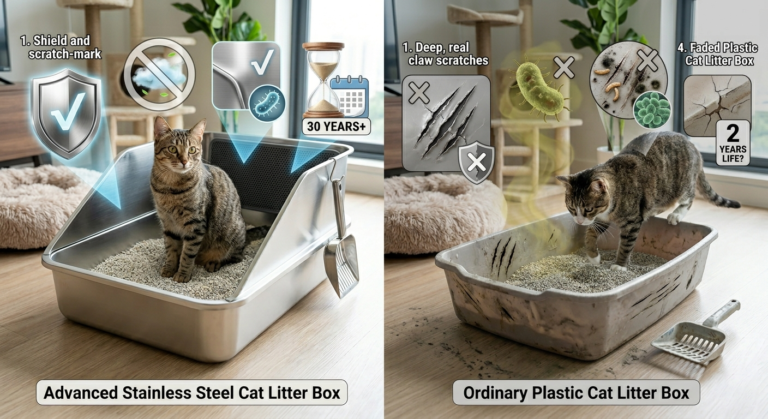
- “Antibacterial” or “sterile”: Stainless steel is a family of alloys, not an automatic antibacterial certification. Microbial performance depends on the exact surface, fabrication, soil, cleaning method, and test protocol.
- “Odor-proof” or “zero odor”: A smooth non-absorbent surface may be easier to clean, but odor is also influenced by litter, waste-removal frequency, seams, residue, ventilation, and cleaning practice.
- “Lifetime” or “rust-proof”: Corrosion and service life depend on alloy, finish, environment, cleaners, damage, and maintenance. Use measured specifications and care instructions instead of unlimited lifespan promises.
- “Food-grade” or “medical-grade”: These phrases should not be used as generic substitutes for an exact alloy specification, supplier documentation, applicable test report, or target-market requirement.
3. A Practical OEM/ODM Validation Process
- Define measurable specifications. Record the alloy or material requirement, sheet thickness, external and usable internal dimensions, entry geometry, corner radii, joint construction, edge finish, accessories, and carton configuration.
- Review production-equivalent samples. Inspect several finished units, not only a raw material coupon or showroom sample.
- Run repeatable use checks. Fill, carry, scoop, empty, wash, rinse, dry, reassemble, and package the product using a written procedure. Record any deformation, sharp contact point, trapped residue, coating change, loose component, or cleaning difficulty.
- Agree inspection criteria. Define sampling, dimensions, appearance limits, functional checks, packaging checks, documentation, and acceptance rules before mass production.
- Approve marketing claims last. Each performance, health, sustainability, or cost-saving statement should match the production design and the evidence available for the target market.
4. Evaluate the Commercial Case With Current Channel Data
Retail price, search demand, review scores, freight cost, return rates, and margin vary by country, channel, seller, product size, and time period. A supplier should not present one unsourced percentage as a universal market result.
- Demand: Review current search terms, competitor assortments, customer questions, and sales data from the buyer’s own target channel.
- Landed cost: Compare unit price, packed dimensions, weight, duties, freight, warehousing, damage allowance, accessories, and after-sales parts.
- Fit for the customer: Check usable space, entry height, containment, cleaning access, and individual cat preferences rather than assuming one design suits every household.
- Differentiation: Prioritize verified design details—such as dimensions, removable components, finished edges, packaging configuration, and documented customization—over superlatives.
5. B2B Buying Checklist
- Request a dimensioned drawing and production-equivalent sample.
- Confirm the material specification and supporting supplier documents.
- Inspect corners, seams, welds, rolled edges, attachments, and removable parts.
- Validate the labeled cleaning method on the finished product.
- Calculate carton and container use from the final packaging plan.
- Define inspection and acceptance criteria in the purchase documents.
- Use only claims supported by the exact SKU and applicable evidence.
Frequently Asked Questions
Is every stainless steel litter box easy to clean?
No. Cleanability depends on the finished geometry, joints, surface condition, removable parts, and cleaning instructions—not just the base material.
Does stainless steel make a litter box antibacterial?
That conclusion cannot be made from the material name alone. Buyers should request a relevant product-specific test before using an antibacterial claim.
How should a buyer compare stainless steel with plastic?
Compare the complete designs under the same use conditions, including dimensions, entry, containment, cleaning access, weight, packaging, durability checks, price, and after-sales requirements.
Procurement Takeaway
Stainless steel may be a strong option when it is paired with suitable dimensions, accessible geometry, controlled fabrication, compatible cleaning guidance, and documented quality requirements.
Review our
stainless steel litter box design guide,
compare the
Younihao product range,
or
contact our OEM/ODM team
with your target market, quantity, packaging, and validation requirements.
Leave a Reply